

Close Air Support in the Vietnam War Page 4
Back To Page 3 In the south, the number and strength of the Viet Cong attacks against US and ARVN forces grew in intensity as a function of the North’s ability to move more men and more effective weapons into South Vietnam. These attacks now were occurring throughout the country. The attacks were further from the […]
Close Air Support in the Vietnam War Page 3
Back To Page 2 The Middle Years – 1965 to 1970 Something was causing the nature of the SEA conflict to change as the war entered the middle 60s. That something was the North Vietnamese escalation of the war. The political instability in the south had encouraged the North Vietnamese leaders to press their military, […]
Close Air Support in the Vietnam War Page 2
Back To Page 1 The tempo of the ground war through the first half of the 1960s was relatively slow. The primary enemy force was the ‘Viet Cong,’ a force of Vietnamese communist guerilla soldiers. The VC did not engage in large battles with US or ARVN (Army of the Republic of Vietnam), but, instead fought […]
Close Air Support in the Vietnam War
by Andy Bush Introduction The air war in Vietnam was a big war. It spanned a lot of years…from the early 60s to the mid-70s. Needless to say, the conflict changed greatly over those years, so, let’s begin with a few definitions. First of all, let’s do away with the term ‘Vietnam War.’ While it may be a […]

Air To Air Gunnery – Theory and Application, Part Two Page 6
Back To Page 5 Inherent problems in early disturbed reticle LCOSS There were immediate problems when the first LCOSS gunsights were introduced in WW2. The first problem area was the acceptance of the system by pilots and aircraft maintenance personnel. The system was mechanically complicated and required careful and exact maintenance by trained technicians. This […]
Air To Air Gunnery – Theory and Application, Part Two Page 5
Back To Page 4 Lead Computing Optical Sight Systems (LCOSS) Understanding how LCOSS came about is to understand gun ballistics. So that is where we will start. Up to now, our discussion of the basics has pretty much dealt with the behavior of a single round. Now, we will move on to investigating to what […]
Air To Air Gunnery – Theory and Application, Part Two page 4
Back To Page 3 OK!! Enough of that stadiametric stuff. Let’s get back to our review of fixed sights. One problem that pilots had with using the ring and bead sight was that the pilot’s head had to be held perfectly still when lining up the ring and bead. This was hard to do while […]
Air To Air Gunnery – Theory and Application, Part Two Page 3
Back To Page 2 Stadiametric ranging Stadiametric ranging uses the relationship of small angles and the arcs they subtend over a given distance. Whew!! I hope you are still with me!! Here is the basic idea. We all are familiar with how we use clock code to define a position around our aircraft. Each one […]
Air To Air Gunnery – Theory and Application, Part Two Page 2
Back To Page 1 The Fixed Sight The first question that comes to some folk’s minds is what does the word ‘fixed’ mean. Simply put, it refers to a sighting reference that does not move. There are several types. Up to the beginning of WW2, the most common was the ‘ring and bead’ sight. Note […]
Air To Air Gunnery – Theory and Application, Part Two
by Andy Bush MiG Kill 1973 Introduction In Part Two, I’ll discuss the various types of air to air gunsights from the point of view that the better you understand their operation and inherent limitations, the better you will be able to effectively use them in your simulations. The emphasis in this article will […]
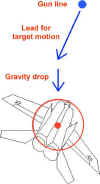
Air To Air Gunnery – Theory and Application, Part One
by Andy Bush Introduction I’ll never forget a piece of F-4 gun film from Vietnam. The F-4 pilot has gotten himself nicely situated at the six of this MiG-21. He’s well within range…maybe 1000’ or less. He’s at low angle off, with his closure under control, and in plane with the MiG. He’s got a good […]

Situational Awareness: Padlock in USAF and Flanker 2
by Andy Bush Ever lawndarted yourself using padlock in BFM? Who hasn’t, right??!! And what’s to blame? Loss of situational awareness (SA), plain and simple. It seems to me to be a good time to take a brief look at some aspects of situational awareness by pointing out some of the differences in padlock design. […]