by Andy Bush
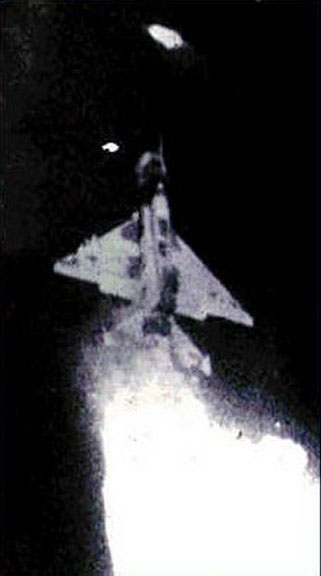
MiG Kill 1973
Introduction
In Part Two, I’ll discuss the various types of air to air gunsights from the point of view that the better you understand their operation and inherent limitations, the better you will be able to effectively use them in your simulations. The emphasis in this article will be on real world theoretical concepts and how well those concepts are modeled in today’s sims.
The thought came to me that I might try a different approach in explaining this subject than is commonly found in sim manuals or other references. This approach will focus on this question. How much, if any, does the particular sight know about the target’s position? Here’s the reason for this. The gunsight computer system needs to know two things to arrive at a valid solution. It needs to know your conditions of flight in order to compute the correct ballistics. And then, it needs to know as much as possible about target behavior in order to compute the lead for target motion.
It is the question regarding target behavior that is the ‘fly in the ointment’…the major variable that is so hard for gunsights to get a handle on. The ballistics problem is secondary…not insignificant…just secondary. Let’s keep our focus then on target behavior as we look at each type of sight. The major aspects of target behavior that we will consider are target range, range rate (closure), and line of sight rate (angular motion across our gun line).
Gunsight Types
We’ll take a look at three types of gunsights…the fixed sight, the disturbed reticle sight, and the director sight. At this time, I must emphasize one thing to the max!!
The air to air gunnery problem is always the same. The only thing that changes is the way we look at it through our HUD. All gunsights try to do one thing…show the pilot where he should aim. While gunsights may look different and may operate with different inputs and assumptions, the bottom line is that they are designed to allow the pilot to point his gun line in the correct direction. For a given situation, there is only one aiming solution.
With that firmly in mind, we’ll move on to the various gunsight types. In each category, we’ll look at two issues…basic operating principle and system implementation. We’ll start with the fixed sight.
Related Posts:
Related posts:
 Air To Air Gunnery – Theory and Application, Part Three Page 10
Air To Air Gunnery – Theory and Application, Part Three Page 12
Air To Air Gunnery – Theory and Application, Part Three Page 16
Air To Air Gunnery – Theory and Application, Part Three Page 5
Air To Air Gunnery – Theory and Application, Part Three Page 10
Air To Air Gunnery – Theory and Application, Part Three Page 12
Air To Air Gunnery – Theory and Application, Part Three Page 16
Air To Air Gunnery – Theory and Application, Part Three Page 5
 Air To Air Gunnery – Theory and Application, Part Two Page 2
Air To Air Gunnery – Theory and Application, Part Two page 4
Air To Air Gunnery – Theory and Application, Part Two Page 5
Air To Air Gunnery – Theory and Application, Part Two Page 6
Air To Air Gunnery – Theory and Application, Part Two Page 2
Air To Air Gunnery – Theory and Application, Part Two page 4
Air To Air Gunnery – Theory and Application, Part Two Page 5
Air To Air Gunnery – Theory and Application, Part Two Page 6