|
|
Joined: Jul 2000
Posts: 2,708
Senior Member
|
|
Senior Member
Joined: Jul 2000
Posts: 2,708 |
After almost a year of shooting wider field targets through refractor telescopes, I decided to go back and image through my Schmitt Cassegrain Telescope (SCT). The SCT has a much longer focal length which equates to higher magnification (you guys already knew that though ;)). That makes things more challenging as any tracking errors are also magnified. The Bubble Nebula (NGC7635) found in the Constellation of Cassiopeia. This one is awaiting some true colour data. In the mean time I ran it through a False Hydrogen Alpha (Ha) action in Photoshop. It should be pretty close to how it should look. 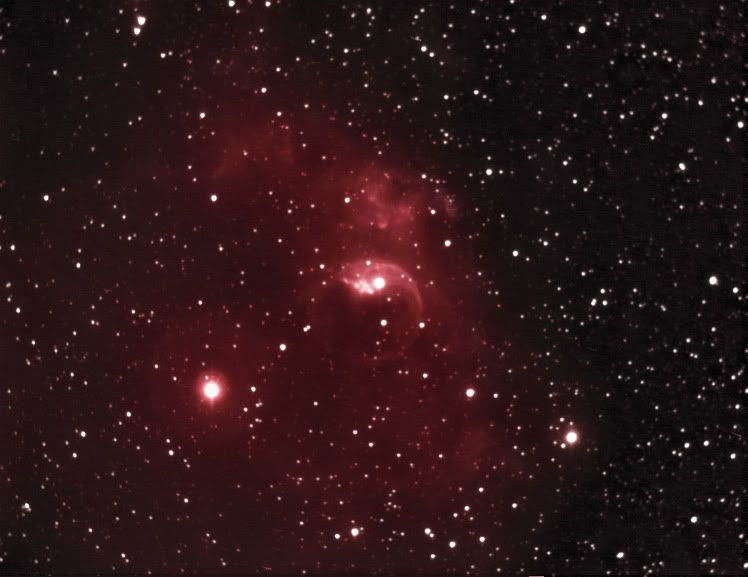 M16 - The Eagle Nebula in the Constellation of Serpens. This is a 'Stellar Nursery'. New stars are being formed in the huge columns of gas and dust. 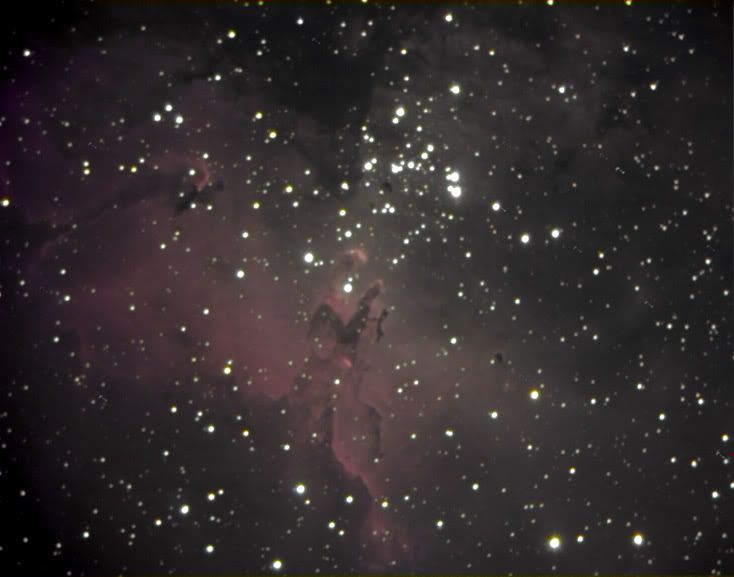 And finally NGC 6946. A Face on Spiral Galaxy in Cephus. It is fairly close to us as galaxies go, a mere 10 million light years. 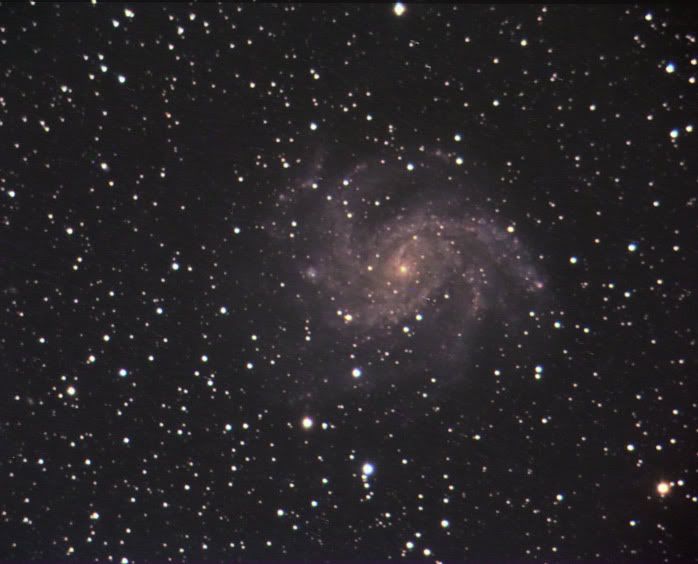
Who are we? We find that we live on an insignificant planet of a humdrum star lost in a galaxy tucked away in some forgotten corner of a universe in which there are far more galaxies than people.
Carl Sagan
|
|
|
|
|
Joined: Jan 2003
Posts: 2,608
Senior Member
|
|
Senior Member
Joined: Jan 2003
Posts: 2,608 |
i love it when you post these shots Paul!! absolutely amazing work  hope u don't mind i did a quick curves tweek along with a little saturation and i have a CA action  
|
|
|
|
|
Joined: Jul 2000
Posts: 2,708
Senior Member
|
|
Senior Member
Joined: Jul 2000
Posts: 2,708 |
Thanks for doing that Bob. It looks great. Sometimes it is hard to judge how best to process these images. Lower contrast can bring out a lot more faint nebulocity while higher contrast brings some nice sharp detail in the more prominent features. Sometimes it is best to do two separate versions that compliment each other (which we have now with your version). Cool stuff!
Who are we? We find that we live on an insignificant planet of a humdrum star lost in a galaxy tucked away in some forgotten corner of a universe in which there are far more galaxies than people.
Carl Sagan
|
|
|
|
|
Joined: Sep 2004
Posts: 11,187 Likes: 36
Veteran
|
|
Veteran
Joined: Sep 2004
Posts: 11,187 Likes: 36 |
Very cool stuff. I wonder if overlaying the two images might provide a combination of more detail and faint features.
It's amazing to see that other galaxy when you consider the size of them - just mind-boggling.
|
|
|
|
|
Joined: Jan 2002
Posts: 1,499
Member
|
|
Member
Joined: Jan 2002
Posts: 1,499 |
Yours are always the most amazing posts, Paul. Thanks for sharing them.
"Enjoy every sandwich" - Warren Zevon
|
|
|
|
|
Joined: Jan 2001
Posts: 24,314
Lifer
|
|
Lifer
Joined: Jan 2001
Posts: 24,314 |
Very cool. Eagle Nebula is appropriately named. 10 million light years huh? Really hard to get one's arms around that isn't it? Fantastically huge our galaxy...
BeachAV8R
|
|
|
|
|
Joined: Sep 2000
Posts: 3,270
Senior Member
|
|
Senior Member
Joined: Sep 2000
Posts: 3,270 |
Steam: Sinner6
Uplay: Sinner76028
MWO: Sinner6
|
|
|
|
|
Joined: Jul 2000
Posts: 2,708
Senior Member
|
|
Senior Member
Joined: Jul 2000
Posts: 2,708 |
Thanks guys:) I am glad you like my images. It is indeed mind boggling to contemplate the distances involved. All the nebulae I image are within our own Milkyway Galaxy. Usually the distances of these objects are in the thousands of light years from us. The Galaxies are far more distant (Millions of light years). The furthest Galaxy I have managed to capture is called IC1296. It is a face on spiral galaxy found in the same part of the night sky as the Ring Nebula (M57). The Ring Nebula is about 2000 Light Years away while IC1296 is estimated to be 200 Million Light Years distant.. that's a long trip anyway you look at it.... 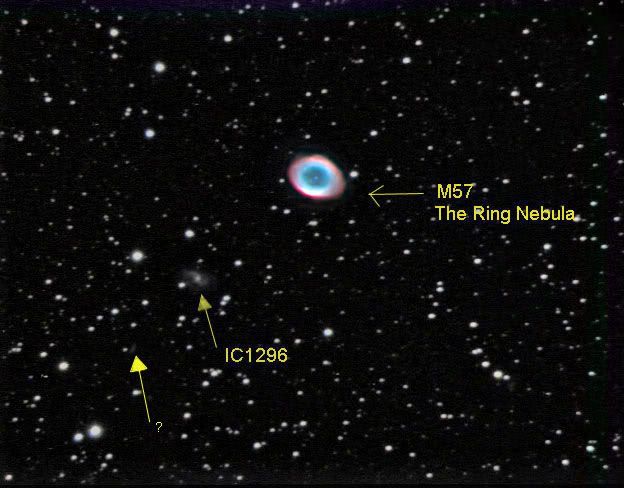 The pointer with the question mark shows a small 'faint fuzzy' in the background. That will be another distant Galaxy but I haven't identified it yet.
Who are we? We find that we live on an insignificant planet of a humdrum star lost in a galaxy tucked away in some forgotten corner of a universe in which there are far more galaxies than people.
Carl Sagan
|
|
|
|
|
Joined: Jan 2001
Posts: 20,152
Lifer
|
|
Lifer
Joined: Jan 2001
Posts: 20,152 |
i love it when you post these shots Paul!! absolutely amazing work hope u don't mind i did a quick curves tweek along with a little saturation and i have a CA action this is such an awesome shot, off to ludicrous speed 
XboxLive Tag: DOBrienTG1969 Dave O'Brien,Top Gun PhotographyNikon D500 & D7200 Nikkor 70-200VR AF-s F/2.8 Sigma 50-500 & 17-50 F2.8 Sigma 150-600
|
|
|
|
|
Joined: Jun 2007
Posts: 53
Junior Member
|
|
Junior Member
Joined: Jun 2007
Posts: 53 |
Paul, What is the red dot circled below? 
|
|
|
|
|
Joined: Jul 2000
Posts: 2,708
Senior Member
|
|
Senior Member
Joined: Jul 2000
Posts: 2,708 |
Good spot Byro ;). That is a 'hot pixel' that showed up while I was taking the red data set. You get hot pixels on all CCD images that use longer exposures. The way to eliminate them is to either cool the CCD (some amateur astronomers go to great lengths to cool their cameras), or you can use 'Dark Frames' that are subtracted from the final image. The camera I have uses this method. You have to take a series of dark frames over a range of temperatures and exposure times. The camera has a temperature sensor and the software will automatically pull an appropriate dark frame from the library (every time I take a dark frame with the lens cap on it is saved to the library with temperature and exposure time information). The selected dark frame is then applied to the current image. You get hot pixels when the temperature changed from that at which the dark frame was taken.
If you look closely there are also some hot pixels in the luminance layer as I can see some small trailing patterns of white pixels across the frame. Basically I need to take more dark frames.
Who are we? We find that we live on an insignificant planet of a humdrum star lost in a galaxy tucked away in some forgotten corner of a universe in which there are far more galaxies than people.
Carl Sagan
|
|
|
|
|
Joined: Jun 2007
Posts: 53
Junior Member
|
|
Junior Member
Joined: Jun 2007
Posts: 53 |
Thanks for the explanation, Paul.
|
|
|
|
|
Joined: Jul 2000
Posts: 2,708
Senior Member
|
|
Senior Member
Joined: Jul 2000
Posts: 2,708 |
Here is the Bubble Nebula image with the colour data added: 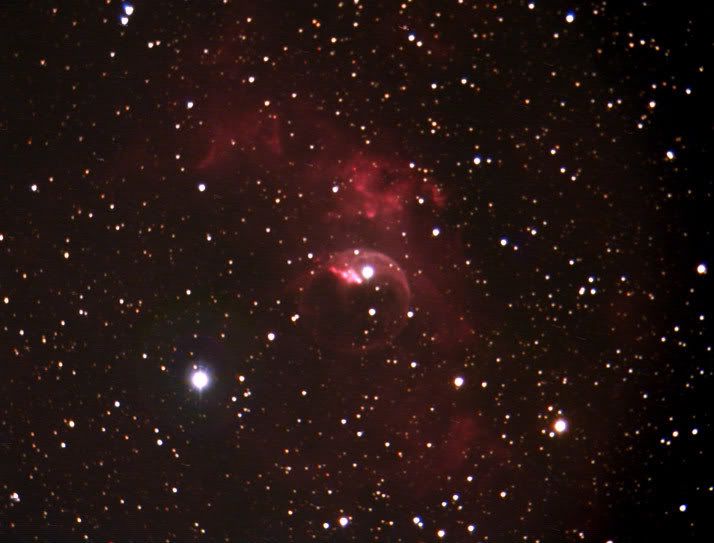
Who are we? We find that we live on an insignificant planet of a humdrum star lost in a galaxy tucked away in some forgotten corner of a universe in which there are far more galaxies than people.
Carl Sagan
|
|
|
|
|
Joined: Jan 2000
Posts: 1,583
Old Guy Member
|
|
Old Guy Member
Joined: Jan 2000
Posts: 1,583 |
Your pictures continue to amaze me.
Core i9 10900k @ 5.0GHz
Corsair H115i CPU cooler
Asus ROG Maximus XII Formula
Asus ROG Strix RTX 2080 OC 8GB DDR6
32GB Team T-Force Night Hawk DDR4 3200,
Corsair HX850i 850W PSU
TIR5 With Trackclip Pro
Win 10 x64
|
|
|
|
|
|
|
|
|
|
|
|
|
HOA's
by Terl9999 - 09/18/26 04:12 AM
|
Football
by Terl9999 - 09/18/26 02:42 AM
|
Flags
by Terl9999 - 09/15/26 10:03 PM
|
|
|
|
|
|
|
|